

Heating paint. The wall heats.
A conductive coating applied between two copper strips. Invisible beneath filler and paint, powered by 24 volts – controlled room by room.
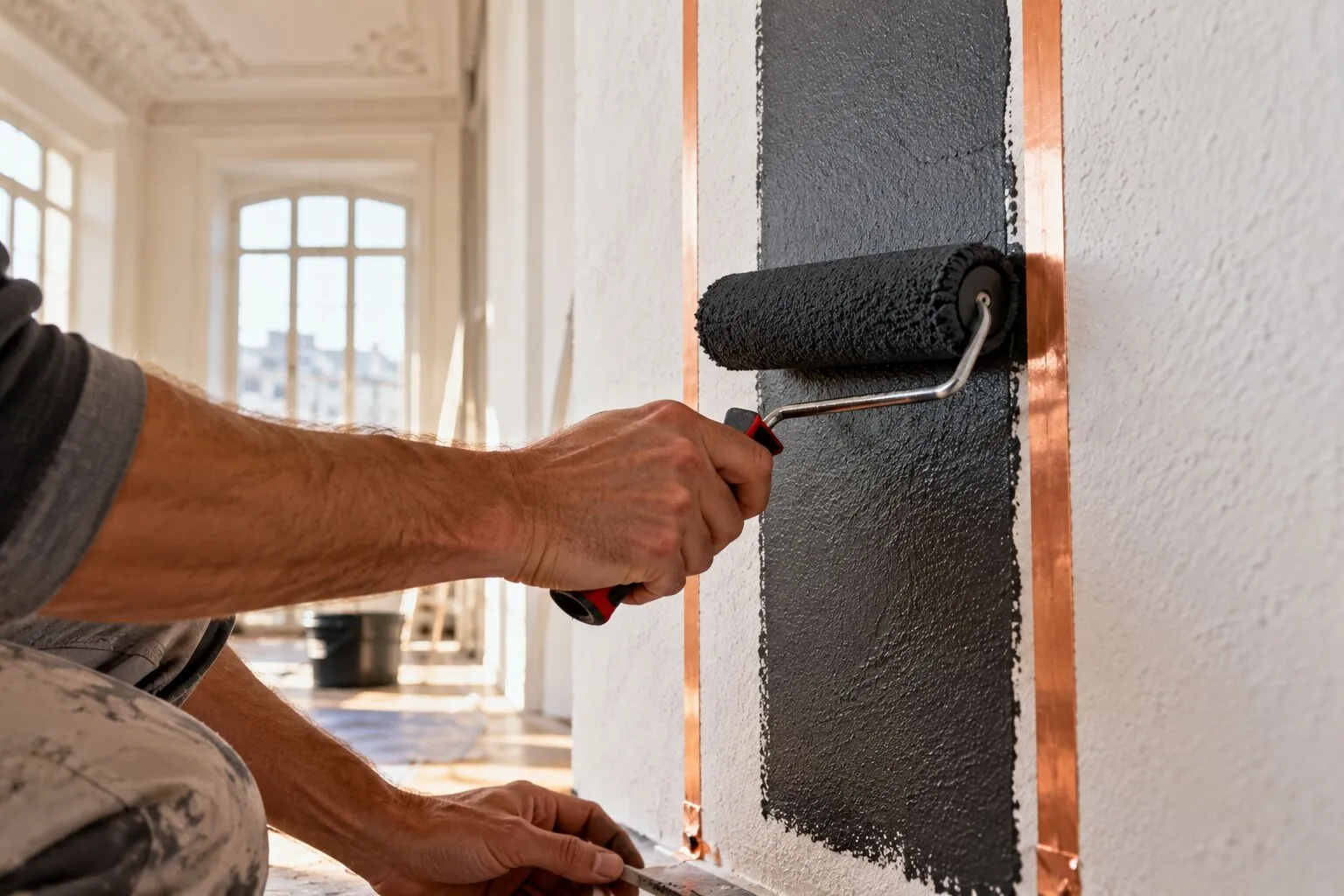
A paint that heats.
An electric surface heating system applied like paint
CARBON4® heating paint is a conductive coating. It is applied between two parallel copper strips on a primed wall, ceiling or floor. A transformer converts mains voltage to a safe 24 volts. When current flows through the coating, the entire surface warms up evenly.
The heating surface is then finished with mineral filler and can be painted, plastered or tiled. The heating is invisible – no radiators, no pipes and no boiler room.
Radiant heat instead of warm air
The surface emits long-wave infrared heat in the range of roughly 0.8 to 50 µm. Rather than primarily heating the air, it warms surfaces, furniture and people – like the sun on a cool day. Cold walls disappear, and there is hardly any air movement or stirred-up dust.
Because the surrounding surfaces radiate heat, a room already feels pleasantly warm at an air temperature of around 20 °C. Every degree less in room temperature can cut heating energy demand by around 6%.
Technical data
| Layer thickness | 0.4–0.6 mm |
|---|---|
| Output per m² | 140–340 W/m² |
| Output per linear metre (0.55 m) | 80–190 W/linear m |
| Heating voltage | 18–48 V (preferably 24 V) |
| Control accuracy | up to 0.2 °C |
| Rated limit temperature | +60 °C |
| Field length | 0,5–10 m |
| Vapour-permeable | sd value < 0.1 m |
| 230 V fuse protection | 16 A, type C MCB |
| Warranty (B2C) | 7-year manufacturer's warranty on heating surfaces and transformer, not on electrical components |
Six steps. Fully documented.
Every CARBON4® project follows the same quality standard – carried out by trained, certified partners.
Site visit
Technical survey on site: rooms, substrate, electrics.
Planning
Design and electrical plan by CARBON4®.
Coordination
Information sheets for all trades involved.
Installation
Following installation rules, by certified partners.
Acceptance
Measurement, function test and thermal image of every heating surface.
Final documentation
Plans, photos, thermal images and report – for you.
Your final documentation
You always know where heating surfaces, cables and transformers are located – when drilling, during later alterations or when selling the house. The documentation is an integral part of the service.
- Acceptance and handover report with measured values
- Location of heating surfaces, cables and transformers
- Photos and thermal images of all heating surfaces
- Operating instructions and control settings
Invisible to the eye. Visible to the camera.
Before it is painted over, the heating paint appears as a black surface. In operation, the thermal imaging camera shows where the heat is generated: right there, across the entire surface.

 Photo · before painting overThermal image · in operation
Ceiling, wall or floor.
From initial consultation to a warm wall.
Initial consultation
30–45 minutes by phone or video call: building, heating, power connection.
Quote
Transparent breakdown of all components.
Planning
Electrical plan with 3D visualisation, transformers and 24 V wiring.
Installation
By certified partners; the 230 V connection is made by a licensed electrical contractor.
Follow-on trades
Filler, paint, tiles – with approved materials.
CARBON4® Complete.
Heating paint as a prefabricated system board: insulation and heating in one build-up – for drywall construction and suspended ceilings, also directly on concrete or hollow-core ceilings, and for damp remediation with full heating.
Active heating boards (Complete) must not be shortened; only passive supplementary boards (Pure) are cut to size.
- Substrate: wall, concrete or hollow-core ceiling
- Wood-fibre insulation board – which also provides the thermal decoupling
- Fine filler
- Double-sided adhesive tape, copper strip
- Glass-fibre mesh over the copper strips
- CARBON4® heating paint
- Fine filler with full-surface mesh
- Fine filler, then final coating
Is heating paint safe for health?
How hot does the surface get?
Can I paint or tile over the heating paint?
Can I drill into a heated wall?
Heating paint, heated wall paint – what is the difference?
Is heating paint a form of infrared heating?
Can I buy heating paint and apply it myself?
How long does heating paint last?
You might also be interested in
Your project. Individually planned.
Initial consultation of 30–45 minutes, by phone or video call.